Weather in Rome

Weather Icon

Italy Rome Tour Blog

Travel tips, Food, Lifestyle, Street Art, Events and Exhibitions in Rome and all around Italy.

trevi fountain

Who started the tradition of throwing the coin in the Trevi Fountain?

You will surely have seen some tourists throw a coin into the Trevi Fountain. Legend has it that if you throw a coin with your back to the pool and then turn around and see it before disappearing into the water, your return to Rome is guaranteed. Who was the first to do it? The Trevi Fountain is one of the capital’s most famous monuments abroad. The fountain, built in front of Palazzo Poli, occupies the whole square that was built precisely for its construction when several buildings were demolished. It is one of the most significant examples of the Baroque style in Rome, but it is above all one of the places where tourists most love to be photographed. Especially in the act of the famous toss of the coin. The rite is used to wish a return to the city. If one day you go to Rome, when you are with your back to the fountain, throw a coin backwards, and do not turn around until it has fallen. The Trevi Fountain is the largest and one of

Read More
circus maximus

Roman monuments: the Circus Maximus in Rome, the largest stadium in history

The Circus Maximus of Rome (or rather what remains) is the largest stadium in history, the largest man-made structure for performances. It was located between the Aventine and the Palatine Hill, and had a capacity of 300,000 spectators. Let’s go and discover all the secrets. Its sandy track, 600 meters long and 225 meters wide, made it the largest stadium in Rome, larger than the Circus Flaminio and the Circus of Maxentius. Legend has it that here, right in the valley, the mythical episode of the rape of the Sabine women took place on the occasion of the games organized by Romulus in honor of the god Consus. Around the circus it was adorned with magnificent arcades, and had two rows of seats. Inside there was a long, wide wall, called Spina, around which chariot races were disputed. Above there were two obelisks, and some temples. The spine was richly decorated with statues, aedicules and temples and there were seven eggs and seven dolphins from which water gushed, used to count the laps of the race. The twelve carceres, the

Read More
colosseum rome

The Colosseum was covered by a giant awning that weighed 24 tons and was operated by 1000 expert sailors

The velarium was a masterful work of engineering. Its positioning, extremely complicated, was carried out by very experienced sailors, a detachment of the Classis Misenensis (military fleet of Miseno), the Roman fleet stationed at the head of Miseno. Modern estimates speak of a total weight of about 24 tons and everything was handled by 1000 sailors. The velarium was a movable fabric cover made up of several hemp sheets (or veils), which was used in Roman theaters and amphitheaters to ensure spectators adequate protection in bad weather or on hot days. The Colosseum had its own velarium, a gigantic curtain that was fixed to 240 protruding support poles, inserted in as many quadrangular holes, corresponding to 240 protruding stone shelves. From their top a complex system of ropes began, along which huge “sails” were opened and stretched, a sort of structure suspended over the arena that allowed the cavea and part of the arena to be covered. A ring in the center favored the ventilation of the amphitheater; to reduce unpleasant odors, jets of scented water and perfumed essences were

Read More
Chef Paolo Magnanimi - roman food Cooking Class

What did the ancient Romans eat?

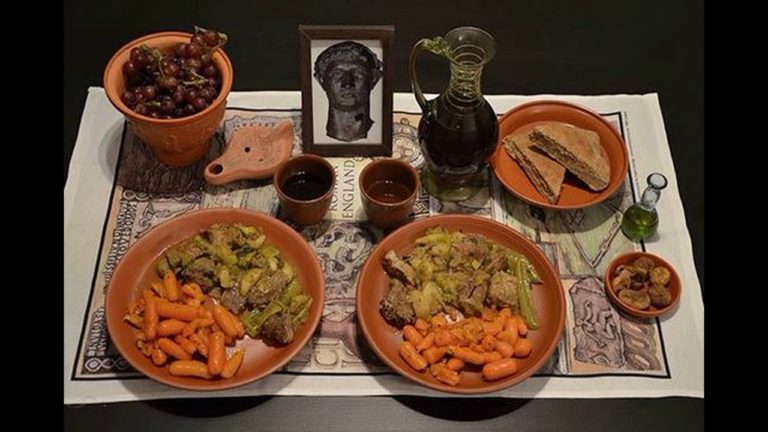
What did the ancient Romans eat? Other times, gastronomic habits have definitely changed: this is why it is not obvious to ask what the Romans ate two thousand years ago. Something remained, habits included, of course… …but the differences, even for the subsequent grafts of new foods and ingredients (which arrived centuries later from the Americas or Asia) are substantial. Let’s see what were the favorite dishes in republican and imperial Rome. Rome and in Roman-influenced circles, three meals a day were eaten: jentaculum, prandium and coena. What we know today comes mainly from the recipe book of Apicius, a well-known gastronome of the imperial age, who wrote the “De re coquinaria”, from here we can draw the greatest knowledge on ancient Roman cuisine. Breakfast, called jentaculum: we drank milk, and ate bread, cheese, honey, dried fruit or even the leftovers from the night before. It was consumed very quickly and the young people ate adipata (pastries) before going to school.In the late morning there was another quick snack based on fish, bread, fruit, legumes and wine called prandium. It

Read More
Piazza navona

The terrible story of the marble head in Piazza Navona

In a Roman palace in Piazza Navona, precisely at number 34, it is possible to see a marble head protruding solitary from the facade. Why is there this isolated face and what does it represent? A popular tradition that has been handed down over the centuries tells that in the second half of the sixteenth century Pope Sixtus V loved to mix with the crowd, disguised as a commoner, to measure his level of popularity among the Romans. The Pope took off his papal clothes, dressed in other less elegant clothes and, mixing with plebeians and common people, listened, trying not to be recognized, that people really thought of him. One day, while entertaining himself in an osteria in Piazza Navona, he listened and heard the speeches of an innkeeper, who made very critical judgments towards the papal power. In fact, the innkeeper complained, repeatedly insulting the Pope, because of a new tax on wine. The next day the innkeeper found a gallows mounted in front of his tavern and this made him happy, because he was looking forward to

Read More
st peter dome rome

From the keyhole of the Villa del Priorato di Malta you can see the Dome of St. Peter

Have you ever seen Sorrentino’s Movie La Grande Bellezza? There is a scene in which the Dome of San Peter is seen… …in the middle of the hedges: it is the Villa of the Priory of Malta, in Piazza dei Cavalieri di Malta, on the Aventine Hill. If you happen to pass nearby, from the keyhole of the large door you can admire the same image. The dome of St. Peter’s Basilica as you’ve never seen it before. The keyhole is the destination of a continuous pilgrimage but not of mass because it is located in an area not very touristy. It is located on the highest part of the Aventine hill, between the Orange Garden and the villa of the Priory of Malta, in the heart of the Circus Maximus area. The emotion of the view for the unwitting tourist is unique. Spying and watching something incredible at the same time: the Dome of San Pietro in a new and singular perspective. And for tourists it seems that the sunset is just the best time to watch from that

Read More
gladiator fights

What happened in gladiator fights?

Who really were the gladiators and what really happened in the Colosseum in Rome and in the other amphitheaters of the Roman Empire? The name “gladiators” derives from gladius, the sword of the past Roman legionary that they also use by wrestlers. The practice of duels between gladiators comes from the Etruscans and like many other aspects of Etruscan culture, this too was adopted by the Romans. The first gladiator show probably took place in 264 BC. In 105 BC the games became public. The gladiators were on average between 20 and 35 years old (in the majority, however, 30), in line with the life expectancy of the time. And the height was also in line with the time: 168 cm. The fighters could be real professionals, new inexperienced gladiators, convicts, criminals, slaves, convicts, prisoners of war, Christians, or free men, without distinction of race or sex (the fights of gladiators, extremely rare, were however always the most requested). Gladiators were trained in special schools. The most prestigious was the Ludus Magnus.The gladiators stayed in cells arranged according to an

Read More
Rome

Rome two thousand years ago had two million inhabitants

Rome in the imperial age, in its moment of maximum splendor, was the largest metropolis in the world. Cosmopolitan, just like New York now. It was the first great gigantic city of humanity, so much so that the number of inhabitants of Augustan Rome was reached only at the beginning of the nineteenth century by London, but above all it welcomed the most important ancient civilization, which influenced society, culture, language, literature, art, architecture, philosophy of the whole Western world, up to the present day. Everything worked despite not being able to count on the benefits of today’s science. If you think about it, it looks almost like a miracle. In the imperial age, Rome had 1,200,000 inhabitants, excluding slaves and immigrants (therefore almost two million). It was already then a cosmopolitan city with monumental buildings, gigantic squares, fountains and statues, and it was also very noisy and chaotic. The first true, great metropolis in history, with gigantic aqueducts, cisterns, containers and markets for food, gigantic neighborhoods and magnificent buildings. Rome was equipped with thermal baths, running water, public baths.

Read More
Rome Fountains

How many monumental fountains are there in Rome?

The fountains of the capital are numerous, and many of these are wonderful, elegant and majestic. Rome is a city where water abounds and these magnificent works of art, especially Renaissance and Baroque, have also become famous thanks to the cinema, so much so that they are counted in films, novels, documentaries and symphonic poems (famous that of Ottorino Respighi, entitled “The fountains of Rome”). In few cities in the world there is such a concentration of such monumental fountains. But how many are they exactly? The ancient Romans attributed great importance to water (and then also the Popes, who always brought a supply of Roman water when they traveled): think of the fountains but also of the majestic aqueducts and the grandiose baths, places of social and crucial work in those times (a bit like our shopping malls now, of course in the pre-Covid-19 era). The sources were born to collect the spring waters and slowly spread throughout the territory. Starting from the Renaissance they began to become gigantic and beautiful: real monumental works of art. The Roman fountains

Read More
gladiators fight at the colosseum

Did you know? 500,000 men and a million animals were sent to die in the Flavian Amphitheater known as the Colosseum

The shows in ancient Rome and in the Colosseum history in particular were numerous, open to all citizens and generally free; some of them were distinguished by the greatness of the preparations and by the cruelty. The Romans preferred gladiator fights, those with ferocious beasts (venationes), reproductions of naval battles (naumachia), chariot races, athletics competitions, theatrical performances of mimes and pantomimes The first gladiator show probably took place in 264 BC. In 105 BC the games became public. The number of gladiatorial shows increased enormously during the Empire. The Flavian dynasty, which began with the emperor Flavius Vespasian, built the largest and most famous amphitheater in the world, the Flavian amphitheater, later known as the Colosseum. Here, according to an approximate count, it is counted that 500,000 men and at least one million animals died. The favorite show was that of horse racing. When the emperor appeared in the circus, in the amphitheater or in the theater, the crowd greeted him by standing up and waving white handkerchiefs, paying homage to him and showing him their presence and emotional, almost

Read More